
Indian Tea Regions: Major Tea-Growing Areas & Signature Teas
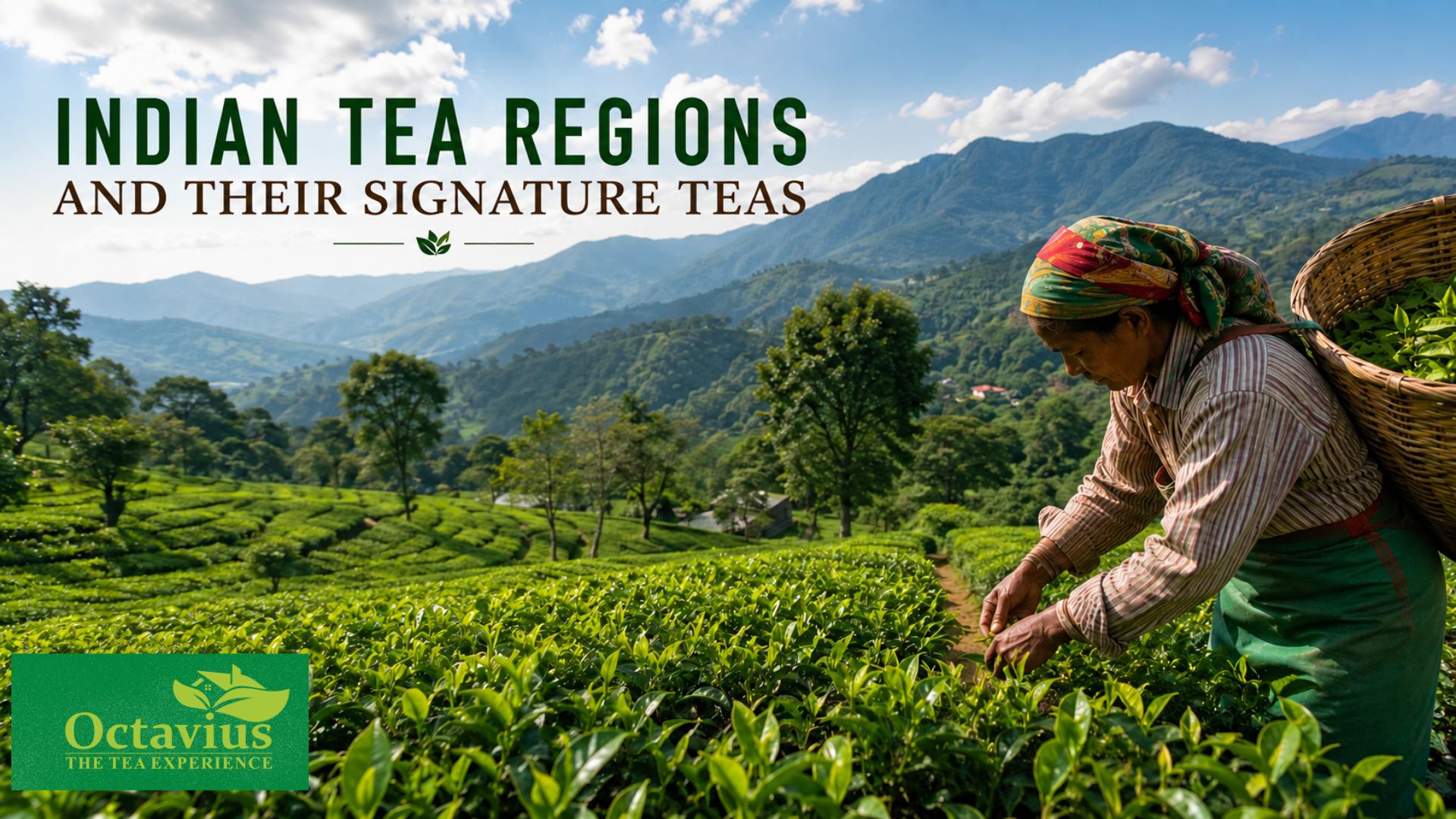
India is one of the world's major tea-producing countries, but Indian tea does not come from one type of landscape. Tea is grown across river plains, Himalayan foothills, high mountain slopes and the Western Ghats, so the climate, elevation, rainfall and soil can change considerably from one region to another. These differences help explain why a strong cup from Assam tastes very different from a delicate Darjeeling or a bright Nilgiri tea.
The best-known Indian tea regions include Assam, Darjeeling, Dooars-Terai, Nilgiri, Kangra, Sikkim and Tripura. Tea is also grown in areas such as the Anamallais, Wayanad, Munnar, Travancore, Karnataka and parts of the Himalayan states. Some regions are known internationally for orthodox tea, while others produce large quantities of CTC tea used for milk tea, tea bags and everyday Indian chai.
This article explains where the main tea-growing regions of India are located, what growing conditions make them different and which tea styles are most closely associated with each region. It also gives special attention to Dooars, where Octavius Tea Resorts operates within working tea estates in the Jalpaiguri district of West Bengal.
Indian Tea Regions at a Glance
| Tea Region | Main Location | Known For | Typical Character |
| Assam | Assam, Northeast India | CTC and Orthodox black tea | Strong, malty and full-bodied |
| Darjeeling | West Bengal | Orthodox black tea | Light, floral and muscatel |
| Dooars-Terai | Northern region of West Bengal | CTC and Orthodox tea | Bright, smooth and full-bodied |
| Nilgiri | Tamil Nadu and nearby southern hills | Orthodox and specialty tea | Fragrant, brisk and bright |
| Kangra | Himachal Pradesh | Black and green tea | Mild, sweet and aromatic |
| Sikkim | Sikkim | Orthodox black, green, white and oolong tea | Floral, smooth and lightly sweet |
| Tripura | Tripura | Mainly CTC black tea | Strong and suitable for everyday milk tea |
Why Does Tea Taste Different Across India?
Most traditional tea comes from varieties of the plant Camellia sinensis, but the finished cup depends on much more than the plant name. Elevation affects temperature and leaf growth, rainfall affects the growing cycle, soil changes nutrient availability, and the plucking season changes the chemistry of the fresh leaf. Processing then adds another layer through withering, rolling, oxidation, drying and sorting.
This is why geography matters so much in tea. Tea grown in the warm, humid Brahmaputra Valley develops differently from tea grown on cooler mountain slopes in Darjeeling or Kangra. Even within the same region, two estates can produce noticeably different teas because of cultivar, altitude, slope, weather and manufacturing style.
- elevation
- annual rainfall
- temperature
- soil and drainage
- tea plant variety
- plucking season
- leaf standard
- orthodox or CTC processing
7 Major Indian Tea Regions to Know
(i) Assam: India's Largest Tea-Growing Region
Assam lies in Northeast India around the Brahmaputra Valley and the Barak Valley. The Indian Tea Association lists around 312,210 hectares under tea, with growing elevations commonly around 45 to 60 metres and annual rainfall of roughly 2,500 to 3,000 mm. The low elevation, high humidity, heavy rainfall and fertile soils create conditions that favour vigorous tea growth.
Assam tea is best known for its dark liquor, strong body and malty character. The region produces large quantities of CTC black tea, which is commonly used for Indian milk tea, masala chai, breakfast blends and tea bags. Assam also produces premium orthodox teas, particularly second-flush teas valued for their richer aroma and fuller flavour.
If you like tea with milk, spices or sugar, Assam is one of the easiest Indian origins to understand. Its strength remains noticeable even after milk is added, which explains why Assam tea appears in so many breakfast and chai blends.
(ii) Darjeeling: High-Grown Tea from West Bengal
Darjeeling is located in the Himalayan hills of West Bengal. The Indian Tea Association lists approximately 17,820 hectares under tea, with elevations ranging from around 90 to 1,750 metres in its regional data and annual rainfall of roughly 3,000 to 3,300 mm. Tea gardens climb steep slopes, where lower temperatures, mist, drainage and seasonal changes slow leaf growth.
The best-known Darjeeling teas are produced by the orthodox method and are generally lighter than Assam teas. A good Darjeeling can show floral, fruity and muscatel notes, depending on the estate and harvest period. The region is particularly known for its first flush, second flush, monsoon and autumn harvests.
The first flush usually produces a lighter and fresher cup, while the second flush develops more body and the ripe fruity character commonly described as muscatel. Darjeeling is therefore better suited to drinkers who enjoy lighter tea without heavy milk or spices.
(iii) Dooars-Terai: A Major Tea Region at the Himalayan Foothills
Dooars-Terai lies below the Darjeeling hills in the northern region of West Bengal. The Indian Tea Association lists about 97,280 hectares under tea for the combined region and annual rainfall of around 3,500 mm. Tea gardens spread across fertile plains and foothill areas that receive water from numerous rivers and streams flowing down from the Himalayas and Bhutan.
Dooars and Terai are sometimes treated as one tea belt, but the landscapes are not identical. Terai lies closer to the lower Himalayan foothills around the Siliguri side, while Dooars stretches farther east through major tea-growing parts of Jalpaiguri and adjoining areas. Tea cultivation is closely connected with forest landscapes, rivers and the foothills in this part of West Bengal.
The region is especially important for CTC black tea. A typical Dooars tea can produce good colour, noticeable strength and a comparatively smooth body, making it suitable for milk tea and everyday blends. Orthodox black tea, green tea and speciality teas are also produced by selected estates.
Dooars tea often sits between two familiar styles. It can have enough body for a strong morning cup without always reaching the heavier maltiness associated with Assam, while remaining fuller than the delicate profile of many Darjeeling teas. This makes the region useful for drinkers who want a balanced black tea with both colour and smoothness.
(iv) Nilgiri: Fragrant Tea from the Blue Mountains
Nilgiri tea comes from the high hills of southern India, particularly in Tamil Nadu. The Indian Tea Association lists around 66,175 hectares under tea, with elevations from approximately 1,000 to 2,634 metres. The high elevations and southern climate allow tea production across a longer part of the year than in many northern regions.
Nilgiri tea is known for fragrance, brightness and briskness. Good orthodox examples can show floral and fruity notes with a clean finish, while the liquor is often bright and clear. These characteristics also make Nilgiri tea useful in blends and chilled tea preparations.
Some high-elevation gardens produce speciality teas during colder winter conditions, commonly described as Nilgiri Frost Tea. These teas can develop concentrated aromas and a lighter, sweeter profile compared with standard everyday grades.
(v) Kangra: Himalayan Tea from Himachal Pradesh
Kangra tea is grown in Himachal Pradesh below the Dhauladhar Range. The Indian Tea Association lists about 2,348 hectares under tea, with elevations around 700 to 1,000 metres and rainfall of approximately 2,300 to 2,500 mm. Tea cultivation developed here during the nineteenth century using tea plants brought to the western Himalayan region.
Both black tea and green tea are produced in Kangra. The black teas are generally milder than Assam and may show gentle sweetness or fruity notes, while green teas can have mild vegetal and woody characteristics. Production is much smaller than in Assam or Dooars, which is one reason Kangra tea is less familiar to many Indian consumers.
(vi) Sikkim: Small-Scale Himalayan Tea
Sikkim is a small Himalayan tea-producing region north of West Bengal. Tea cultivation in the state began with Temi Tea Estate in 1969, and Tea Board India describes tea growing at elevations of around 1,000 to 2,000 metres. The cool mountain environment produces teas that are often compared with nearby Darjeeling but still have a regional identity of their own.
Sikkim produces black, green, white and oolong teas. Tea Board India describes first-flush teas as light and floral, while later harvests can become fuller and more rounded. The relatively small scale of production means Sikkim tea is less common in mainstream retail than Assam or Darjeeling.
(vii) Tripura: CTC Tea from Northeast India
Tripura has a tea history dating to 1916. Unlike several older Indian tea regions where European planters played the main role in commercial expansion, Tea Board India notes that organised tea cultivation in Tripura developed through Indian enterprise with support from the former princely state. The region receives around 2,100 mm of annual rainfall and has temperatures that can range approximately from 10°C to 35°C.
Tripura mainly produces CTC black tea, with smaller quantities of green tea. These teas serve the large Indian market for milk tea, blends and everyday consumption rather than being known mainly as limited speciality teas. Tea remains an important organised industry in the state.
Other Tea-Growing Regions of India
Assam, Darjeeling and Nilgiri are the names most international tea drinkers recognise first, but India's tea map is much wider. The Indian Tea Association also identifies important southern growing areas across the Western Ghats, while Tea Board India recognises traditional and newer tea-producing states across both northern and northeastern India.
(i) Anamallais
The Anamallais lie between Tamil Nadu and Kerala. The Indian Tea Association lists about 12,625 hectares under tea, with elevations of roughly 900 to 1,600 metres and high annual rainfall. Teas from this region can show briskness, body and biscuity to floral characteristics.
(ii) Munnar and the High Ranges
Munnar in Kerala is surrounded by some of India's highest tea-growing landscapes. Estates in the High Ranges grow tea across elevations reaching more than 2,000 metres in some areas. The combination of mountain conditions and established plantation infrastructure has made Munnar one of the best-known tea landscapes of southern India.
(iii) Wayanad
Wayanad lies across the hill region of Kerala near the Nilgiris. Tea shares the landscape with coffee, forests and other plantation crops. The Indian Tea Association describes teas from this area as generally mellow and full-bodied, with moderate briskness.
(iv) Travancore
The tea-growing areas historically grouped under Travancore include parts of the high ranges of Kerala. The region combines elevated plantation land with heavy seasonal rainfall. Teas from this area commonly contribute to the larger South Indian tea trade rather than being marketed internationally under one single famous regional name.
(v) Karnataka
Tea production in Karnataka is much smaller than coffee production, but tea is grown in selected hill areas. The Indian Tea Association lists production from areas around the Western Ghats, including regions better known for coffee cultivation. These teas tend to form a smaller part of India's overall tea output.
(vi) Other Himalayan and Northeastern Areas
Tea is also cultivated in states such as Uttarakhand, Arunachal Pradesh, Meghalaya, Manipur, Mizoram and Nagaland. Tea Board India has identified several of these as newer or non-traditional tea-growing areas compared with the older plantation regions. Small growers and speciality producers are increasing the variety of Indian tea origins available beyond the historically dominant areas.
Orthodox Tea and CTC Tea: What Is the Difference?
Geography gives tea its raw material and growing character, but manufacturing strongly affects the final cup. Two estates in the same region can produce very different tea when one follows orthodox processing and the other produces CTC. Understanding these two methods makes the regional differences easier to appreciate.
(a) Orthodox Tea
Orthodox tea is generally manufactured through stages such as withering, rolling, oxidation, drying and sorting while retaining more of the original leaf structure. This method is closely associated with premium teas from Darjeeling, Nilgiri, Kangra and Sikkim, although Assam and Dooars also produce orthodox teas. The resulting cup can show more visible seasonal and aromatic differences.
(b) CTC Tea
CTC means Crush, Tear and Curl. The machinery breaks tea leaves into small, dense particles that infuse quickly and produce strong colour and flavour. CTC tea is especially important in Assam, Dooars-Terai and Tripura, where it is widely used for milk tea, masala chai, tea bags and strong everyday blends.
How to Choose an Indian Tea by Taste
You do not need to remember every tea region before choosing a tea. Start with the type of cup you normally enjoy, then use the region as a guide. A person who drinks milk tea every morning will usually look for a different leaf than someone who prefers a light cup without milk.
- Strong milk tea: Assam CTC, Dooars CTC or Tripura CTC
- Masala chai: Assam or Dooars CTC
- Light floral tea: Darjeeling first flush or Sikkim orthodox
- Rich aromatic black tea: Darjeeling second flush or Assam orthodox
- Bright and fragrant tea: Nilgiri orthodox
- Mild Himalayan tea: Kangra black or green tea
- Less common Indian origin: Sikkim, Kangra or speciality Dooars orthodox tea
Why Dooars Is Important to the Indian Tea Map
Discussions about Indian tea regions often begin with Assam, Darjeeling and Nilgiri. Dooars deserves a clearer place in that conversation because it is part of one of India's major tea-producing belts and has a very different physical landscape from neighbouring Darjeeling. Tea estates stretch across broad foothill plains rather than steep high mountain slopes, while forests, rivers and the Bhutan foothills remain closely connected with the plantation landscape.
At Octavius Tea Resorts, this relationship can be seen directly at Sylee Bungalow inside Sylee Tea Estate, Damdim and Nya Sylee Bungalow inside Nya Sylee Tea Estate, Nagrakata. Both properties are located in Jalpaiguri district, where tea cultivation is a major part of the regional landscape.
Travellers interested in understanding how plantation tea connects with the final cup can also read about the tea experience in Dooars. A working estate gives more context than tea tasting alone because you can see tea bushes, plucking areas, plantation roads and, when estate operations allow, parts of the manufacturing process.
Frequently Asked Questions About Indian Tea Regions
Q1. What are the main tea-growing regions of India?
The best-known Indian tea regions include Assam, Darjeeling, Dooars-Terai, Nilgiri, Kangra, Sikkim and Tripura. Tea is also grown in areas such as Anamallais, Munnar, Wayanad, Travancore, Karnataka and several Himalayan and northeastern states.
Q2. Which is the largest tea-growing region in India?
Assam is India's largest major tea-growing region and one of the world's largest continuous tea-producing areas. Its warm, humid lowlands and heavy rainfall support large-scale production of both CTC and orthodox tea. Assam is particularly important for strong black tea used in milk tea and blends.
Q3. Which Indian tea region is famous for muscatel tea?
Darjeeling is best known for the muscatel character associated particularly with high-quality second-flush teas. The combination of mountain elevation, climate, tea plant material and seasonal harvesting gives Darjeeling its distinctive flavour profile. Genuine Darjeeling tea is closely tied to its recognised geographical origin.
Q4. What is Dooars tea known for?
Dooars tea is commonly associated with bright liquor, good strength and a smooth, full-bodied cup. The region produces large quantities of CTC black tea suitable for milk tea and blending, along with orthodox and speciality teas from selected estates. Dooars forms part of the wider Himalayan foothill tea belt of West Bengal.
Q5. What is the difference between Assam and Darjeeling tea?
Assam tea is generally stronger, darker and maltier, while Darjeeling tea is usually lighter, more aromatic and more strongly influenced by seasonal flushes. Assam comes mainly from low, warm river valleys, while Darjeeling grows on cooler Himalayan slopes. These differences in geography help create very different cups.
Q6. Which Indian tea is best for milk tea?
Assam CTC and Dooars CTC are two of the most practical choices for milk tea because they produce strong colour and flavour quickly. Their body remains noticeable after milk and sugar are added. Tripura CTC and strong regional blends can also work well.
Q7. Which Indian tea regions produce green tea?
Green tea is produced in several Indian regions, including Kangra, Sikkim, Nilgiri, Assam, Dooars and Tripura in varying quantities. Some regions are much more strongly associated with black tea, but speciality producers increasingly manufacture green, white and oolong styles as well.
Q8. Can travellers visit tea-growing regions in India?
Yes, several Indian tea regions also support tea tourism, but tea estates are working agricultural properties rather than public parks. Access to plantation sections, factories, photography and tea activities depends on individual estate rules and production schedules. In Dooars, visitors can stay within working tea estates at Octavius properties and learn more about cultivation through organised experiences.
Understanding India Through Its Tea Regions
There is no single flavour that represents Indian tea. Assam produces strong, malty black tea from warm river plains, Darjeeling produces lighter seasonal teas from Himalayan slopes, and Nilgiri is known for fragrant, brisk teas from southern hills. Kangra, Sikkim, Tripura and the other growing areas add more variation to India's tea map.
Dooars-Terai is especially important because it shows how a major tea-producing region can exist beside forests, rivers and Himalayan foothills while producing teas designed for both everyday drinking and speciality markets. Understanding these regional differences makes it easier to choose tea by flavour, processing method and drinking style rather than treating all Indian tea as one category.
The next time you drink a cup of Indian tea, look beyond the word tea on the packet. The region can tell you a great deal about the climate, landscape, manufacturing style and likely character of the cup before you even brew it.